Eureka S1E1
A lot of my favourite science fiction television came out in the 90s or early 2000s. These are the shows that I can happily rewatch and, in my opinion, have some of the best storytelling of the genre. One of these shows is Eureka, which started in 2006 and ran for five seasons.
In a nutshell, it’s about a small town full of scientists conducting mostly top secret (and entirely implausible) research. Their experiments tend to cause potentially town-destroying, world-ending, or spacetime-disrupting complications. These complications often turn out to be completely reversible once the right solution is found. While it has its share of emotional moments, it’s definitely more in the light-hearted sci-fi camp. Many of the story lines are inspired by real scientific concepts, but it is far from hard science fiction. The concepts are usually stretched to absurdity. Story comes before realism, and it’s a very fun show to watch.
Episode One shows how a U.S Marshal (Jack Carter) becomes the new town sheriff. The plot revolves around an experiment gone wrong resulting in a breakdown of the laws of physics. Chunks of matter are being displace and/or disintegrated at random. The town geniuses are trying to figure out why and how to stop it. As first episodes do, it introduces core characters, such as:
Jack Carter - Aforementioned U.S. Marshal,
Zoe Carter - Jack’s delinquent teenage daughter,
Allison Blake - Scientist and DoD Agent,
Henry Deacon - Former NASA Engineer turned repair guy and inventor, etc,
Jo Lupo - Ex Special Forces turned sheriff’s deputy,
Douglas Fargo - Scientist with a tendency to push buttons he shouldn’t.
The disaster is unfolding as Jack and Zoe happen to be stuck in town waiting for their car to be repaired. The scientist responsible and his wife are trying to keep his mistake a secret, but have to ask for help when their son goes missing, possibly as a result of the matter displacement. The local authorities (particularly, Sheriff Cobb, Jo, and Allison) are trying to keep the nature of this top secret town from their guests while, grudgingly, realising Jack’s experience as a U.S. Marshal might actually be helpful to their situation. By the end of the episode the town needs a new sheriff, and Jack gets the job.
Like most sci fi shows, Eureka ramps up a little slowly resulting in a pilot that’s actually two episodes long. Most sci-fi fans are used to this and willing to give a new show at least a couple of episodes before passing judgment. It also suffers from a problem common in a lot of fiction in general. When characters are first introduced, their key character traits are too exaggerated. For example:
Jo Lupo, the ‘tough deputy’ with a special forces background, spends most of the episode scowling while wielding, or disassembling and reassembling, weapons. Some of them look like they belong in the hands of a far-future assault team:
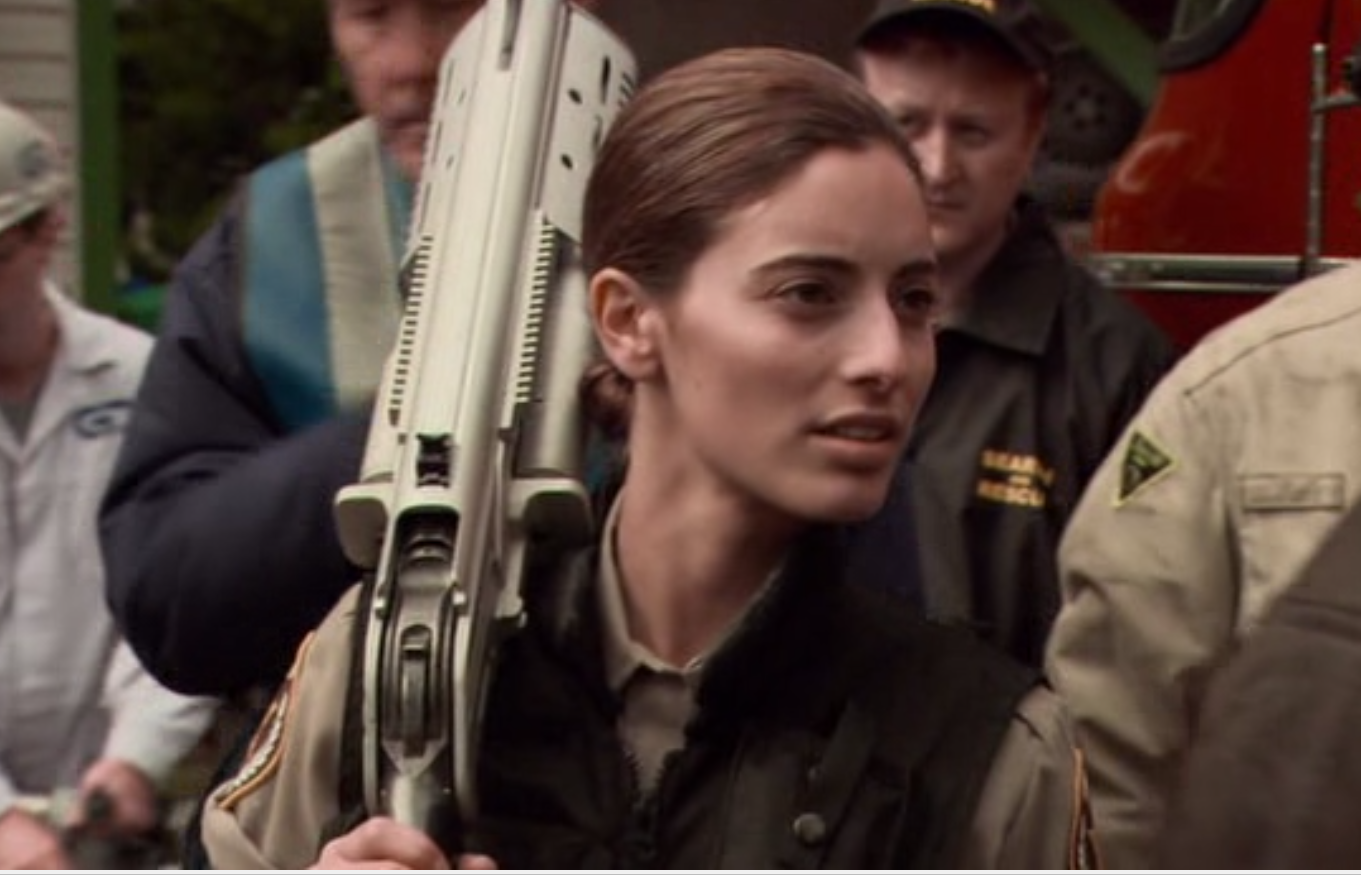
Deputy Jo Lupo
Zoe is an overly-angsty teen always rolling her eyes at the world:
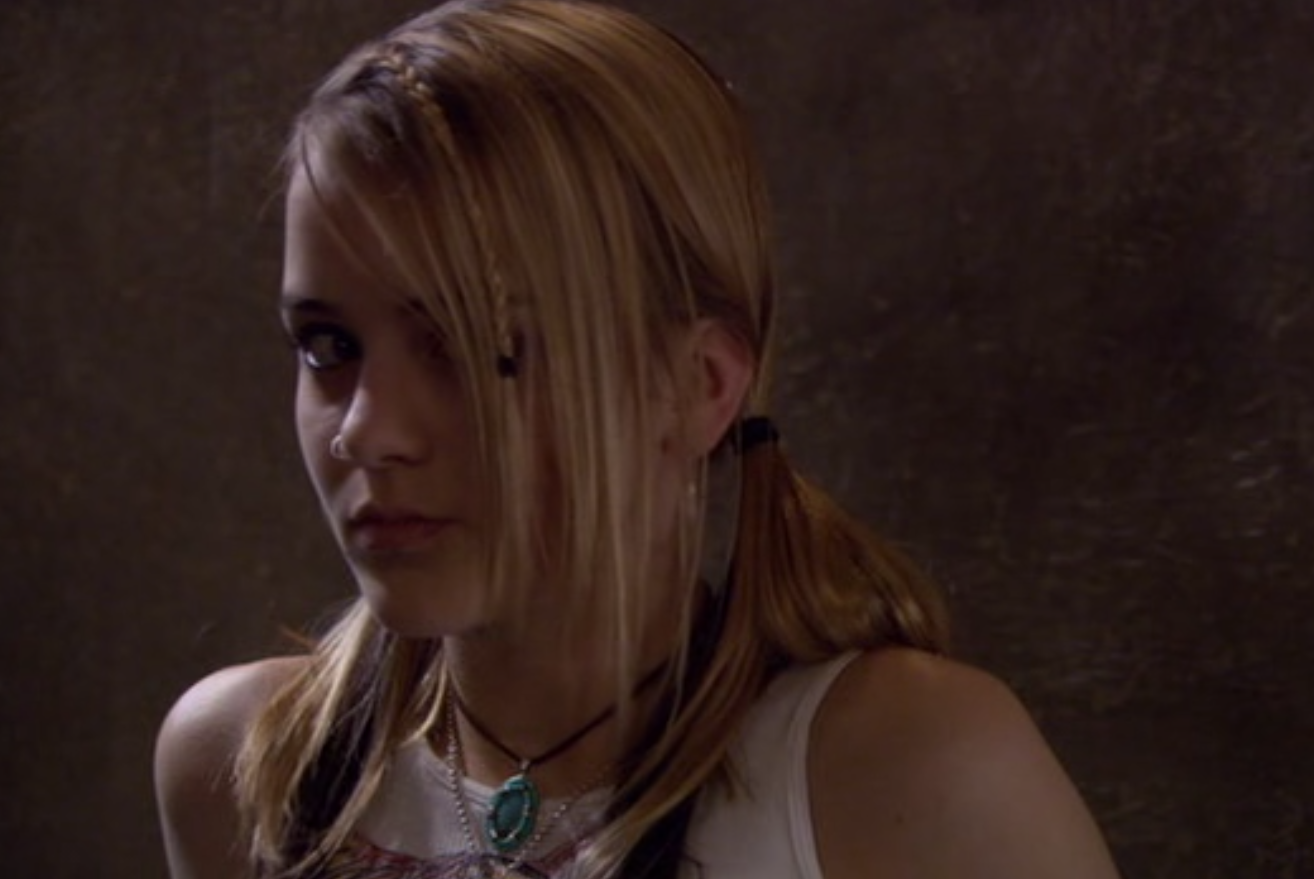
Zoe Carter
It seems at the beginning of many new shows there’s this fear the audience won’t understand the characters if their main traits don’t smack you in the face. Fortunately, in shows with good writing and good acting, the characters eventually mellow into something more believable.
What irks me about this episode:
1) Allison Blake has a son, Kevin, who is autistic. He also just happens to be a super genius. In fiction, it is often treated as a given that autistic = genius. In reality, this is not the case. I’ve met plenty of people with autism at various places along the spectrum. Some of them are indeed very intelligent. Some have unique talents that may, or may not, be useful (like dragging a chair across the floor and then hitting the corresponding note on the piano). I’ve yet to witness one counting cards or mentally solving complex calculus equations in seconds. Such people may very well be out there, but such genius is not a guaranteed feature of autism.
I have learned to roll with this stereotype in fiction; it does make for a good plot device. That said, I can’t help but roll my eyes when, in a room full of scientists and mathematicians, the savant autistic child is the one to solve the math equation that saves the day.
2) There are some characters introduced in the episode who I like but are never seen again. Particularly, Colonel Briggs and Sheriff Cobb. But pilots get made without any guarantee the show will continue. Some actors might only be hired for the one episode, others might have other commitments by the time the show is picked up. Them’s the breaks. On the bright side, both actors appear in Stargate SG-1, another favourite of mine.
What I like about this episode:
1) The overall vibe of the episode, and the show in general, is fun and optimistic. While I do enjoy dark and gritty sci fi too, it’s nice to have a show I can put on without worrying I’ll be depressed or in existential crisis by the end of the episode. The humour is well timed and executed too. In other words, it doesn’t ruin suspenseful or emotional moments.
2) There is a good balance in the way the main characters interact and contribute to the plot. There are too many stories these days where you have ‘competent character’ constantly showing up, or putting down, ‘incompetent character’ in ways that are supposed to be clever and funny, but really come across as, ‘competent character’ is an asshole.
Though it isn’t expressly stated in episode one, Allison Blake is an MD and a PhD. Jack Carter is not. She is on her home turf and he is not. It would be very easy to write their interactions with her always lording her authority and intelligence over him, making him look like an idiot. I suspect if this show were written today rather than twenty years ago that is, in fact, how it would go down.
While Jack is often humbled in this episode, he is also the one who notices key details that lead him to find the missing boy. Despite his lack of scientific knowhow, he has good problem-solving and investigative skills that allow him to contribute to averting the cataclysmic catastrophe. He doesn’t find the solution, but his observations and empathy make it easier for the others to get to the bottom of it, and easier for Kevin when it comes time to solve that math equation and save the day.
The combination of genius, usually from Allison and Henry, and common sense from Jack leading to averting disaster is pretty much the formula for the show. Eureka is well written and the acting is good too. Jo and Zoe become likeable and well-rounded characters as the show goes on. Kevin pretty much stays the same, until he dramatically changes thanks to some timeline shenanigans. I have thoughts on that episode too, but those are for another day.